


 zajezdnia
 ogród doświadczeń
 hangar czyżyny


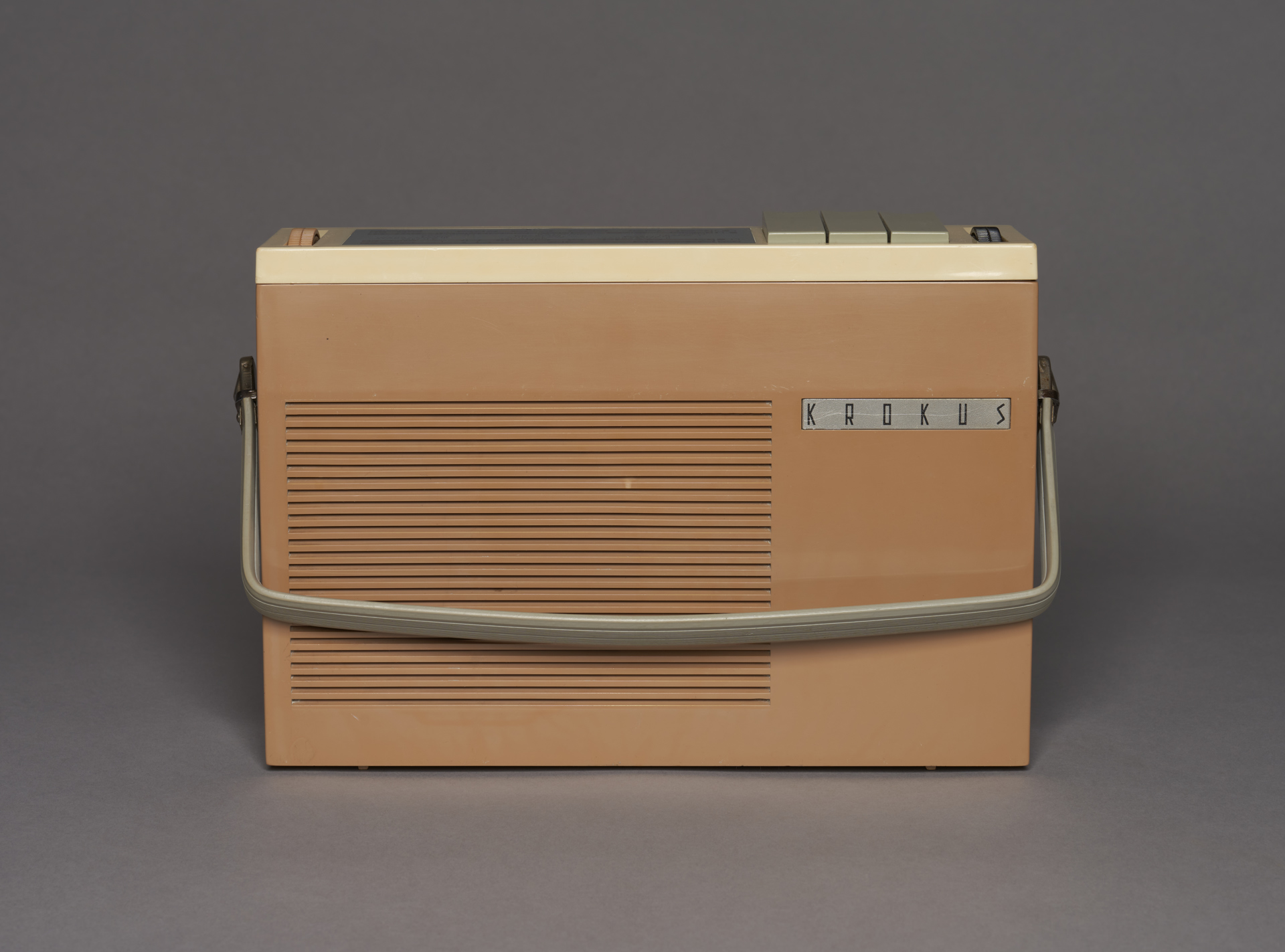

Krokus radio receiver
Zakłady Radiowe Diora, / 1965 - 1966Creator
Zakłady Radiowe Diora
Time and place of creation
Time:
1965 - 1966
Place:
Poland
The Krokus type 10501 radio was manufactured in 1965 by Zakłady Radiowe Diora in Dzierżoniów. It is one of the first Polish designs using transistors and a printed circuit board as components of the electrical system. It is a mains-powered or, when the need arises, a battery-powered superheterodyne equipped with 8 transistors and 2 germanium diodes. Inside the housing there is a built-in ferrite antenna and a Tonsil GD 12,5/15FW speaker. The Krokus is designed to receive radio waves in long, medium and short wave bands using amplitude modulation (AM). The device was the first Polish portable transistor receiver that offered the ability to receive the short wave band. The Krokus was also a multifunction receiver, designed for travel or home use. It is also the first Polish radio designed to be used in passenger cars. In order to enable installation of the device in a car, the scale with two knobs and the three button switches were placed in the top wall of the housing. Furthermore, the receiver was equipped with a car antenna socket and a multi-contact connector. The detachable handle, mounted on the body, allows the radio to be carried and conveniently supported in the horizontal position. To install the Krokus in this position under the dashboard of cars such as the Warszawa, Syrena, Trabant, Octavia or Wartburg, special mounting brackets had to be used, which were sold together with the radio.
The Krokus presented here is untypical. It was probably assembled by an amateur from parts available in shops of the Bureau for Trade in Machines and Materials (Biuro Obrotu Maszynami i Surowcami – BOMIS) network. It was a trading agency, as well as wholesaler and retailer of substandard goods and parts from returns and warehouse stocks. The electronic parts it sold usually came from returns or did not meet the required standards. The origin of the radio seen here is suggested by the stamp “brak” (Eng.: rejected) on the tuning unit, the absence of an antenna socket (at the respective hole in the housing), as well as the self-made battery tray and range switch. DIY attempts were encouraged not only by the technical education system in communist Poland, but also by magazines such as the “Młody Technik” (Eng.: “Young Technician”) or the “Radioamator i Krótkofalowiec” for radio and ham radio amateurs, where design diagrams were printed. Promotion of technology and inventive resourcefulness in the conditions of a deficit economy was also significantly boosted by the “Zrób to Sam” (Eng.: Do It Yourself) television programme, which was broadcast without interruption between 1959 – 1983.
Author: Filip Wróblewski
Krokus radio receiver
Zakłady Radiowe Diora, / 1965 - 1966Creator
Zakłady Radiowe Diora
Time and place of creation
Time:
1965 - 1966
Place:
Poland
