


 zajezdnia
 ogród doświadczeń
 hangar czyżyny


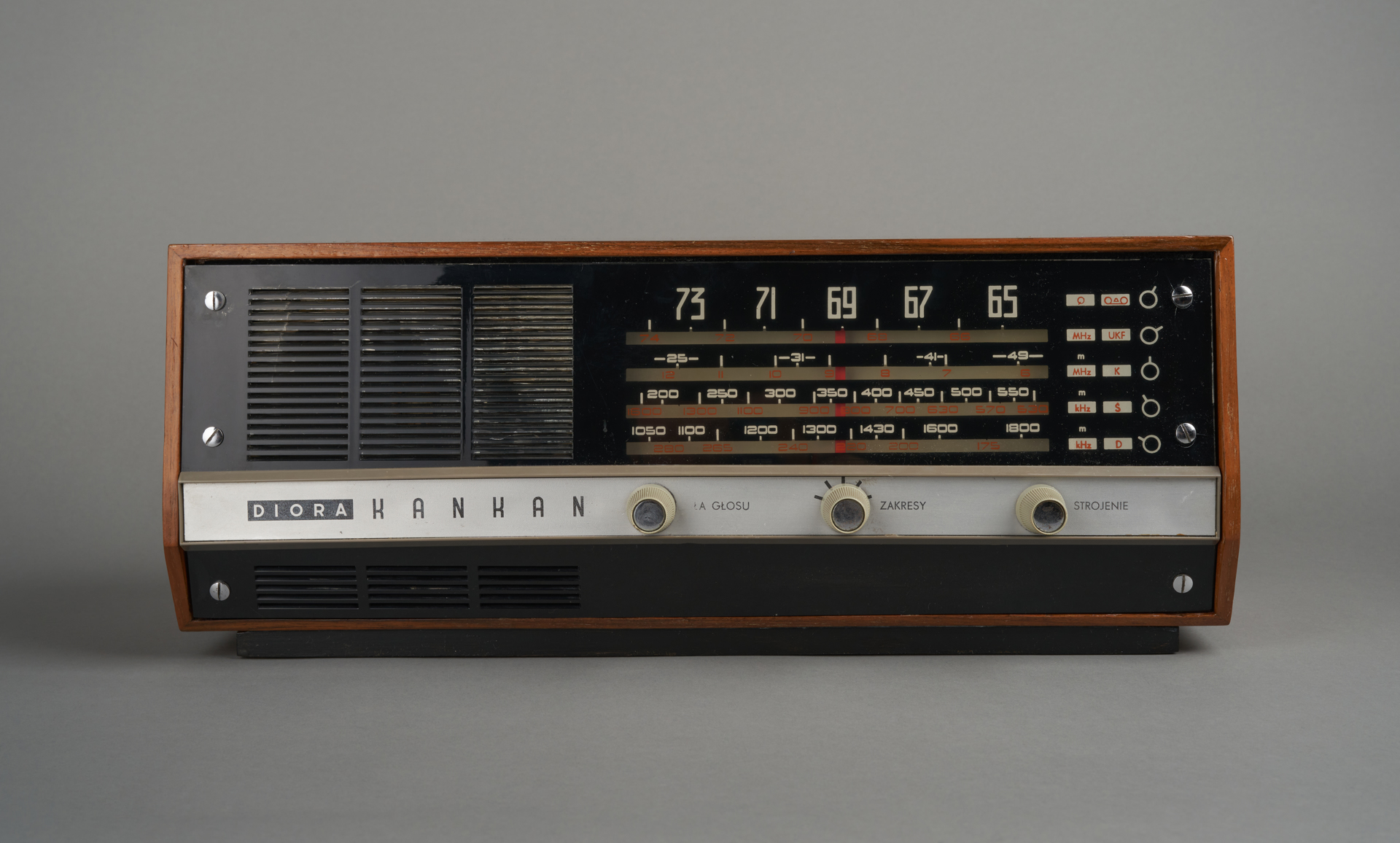

Kankan radio receiver
Zakłady Radiowe Diora, / 1967Creator
Zakłady Radiowe Diora
Time and place of creation
Time:
1967
Place:
Poland
The Kankan radio was manufactured by Zakłady Radiowe Diora in 1966-1969. It is a four-valve superheterodyne equipped with two germanium diodes. The chassis of the device is made of a printed circuit board to which electronic components are mounted. It was, at the time, a relatively new solution introduced at Diora in the early 1960s. The Kankan was designed to receive radio waves in UHF, short, medium, and long wave bands. It has a broadband magnetoelectric Tonsil GD 14,5-9,5 speaker and a ferrite antenna. On the back panel there are sockets for a connecting an external antenna, a ground wire, a tape recorder, gramophone, or an additional speaker. It is an AC-powered tabletop radio.
The Kankan has an elongated, slightly flattened, shape. The housing of painted plywood was made by Spółdzielcze Zakłady Wyrobów Drzewnych Technodrzew in Dzierżoniów. The lower, top, and rear panels are rectangular. The side panels are roughly square in shape and have two triangle cutaways at the top and bottom ends of their front edges. Between them there is a short section of the original edge of the wall. The shape follows the shape of the front panel, slightly retracted inside the housing. The panel is divided into three rectangular areas made of plastic: the upper and lower part are black, the middle section is in a milky grey colour with beige-grey edges. The lower and middle sections are of similar height, while the upper panel is three times the height of either of them. The bottom and top part of the panel are angled. In the top part, on the left, there is a speaker grille, and the scale occupies the right side. In the middle part is the radio’s name and three potentiometers: the power and volume knob, the range switch, and the tuning knob. On the bottom part on the left is a ventilation grille. The entire design keeps to minimalist aesthetics, as was typical for communist countries. Its characteristic feature is the use of geometric shapes and patterns, which is reflected in the blocky typeface in which the names and digits on the device are rendered. The same aesthetics are also achieved by juxtaposing materials such as shiny metal, flat-coloured plastic and wood with an organic grain pattern.
The Kankan receiver was also manufactured in two variants that were different to the one described here. The Kankan II (made in 1967-1968) uses three vacuum tubes and is not able to receive the UHF band. The cuboid housing of the Kankan 3 (of 1968) is fully made of wood, and the flat front panel is made of black plastic: the speaker is installed directly in the housing. The Kankan’s twin model is the Sarabanda radio, which only differed in its Bakelite housing.
Author: Filip Wróblewski
Kankan radio receiver
Zakłady Radiowe Diora, / 1967Creator
Zakłady Radiowe Diora
Time and place of creation
Time:
1967
Place:
Poland
