


 zajezdnia
 ogród doświadczeń
 hangar czyżyny


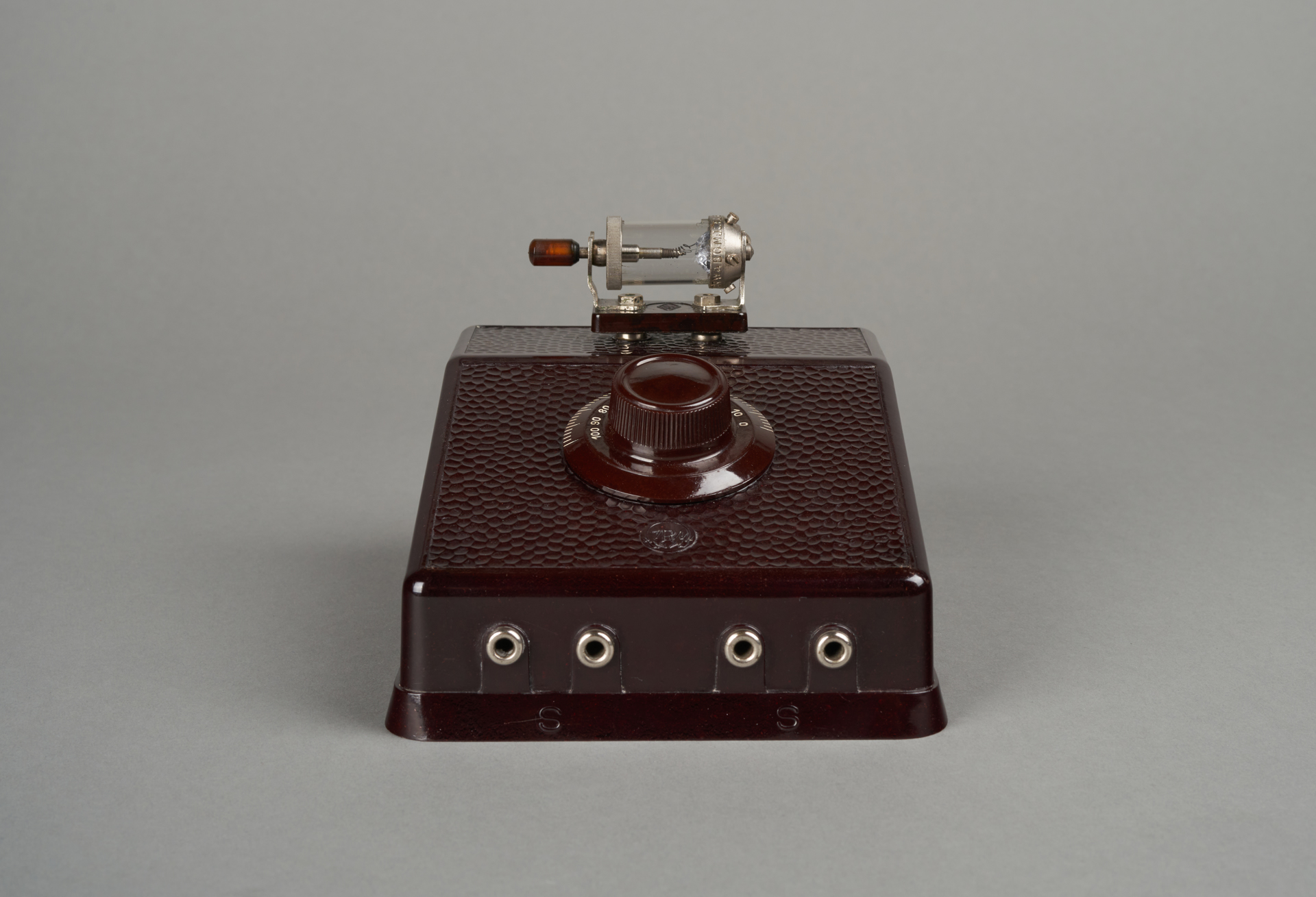

D12 detector radio receiver
Zakłady Radiotechniczne Natawis,Creator
Zakłady Radiotechniczne Natawis
Time and place of creation
Place:
Poland
The D12 detector radio, produced by Zakłady Radiowe Natawis in Warsaw, is a single-band device for individual reception of radio broadcasts on medium wave. The use of the receiver did not require an external source of electricity, but it was necessary to use one of two pairs of earphones to listen to the radio.
The electrical system of the device is enclosed in a black Bakelite housing. The radio is tuned using a knob with a scale. There are two earphone sockets in the front wall. On the top plane is a crystal detector socket, the container of which is made of metal and glass. Inside the container is a galena crystal, to which a thin steel wire is attached. The wire is mounted to a control on a ball bushing for closing the circuit, isolated by a plastic handle. This enabled the creation of a metal-semiconductor rectifying connection. The mechanism of alternating current rectification was discovered by Karl Ferdinand Braun in 1874. Thanks to this achievement, as well as the development of the rectifier and a crystal detector, he was awarded the Nobel Prize in physics in 1909.
The Wabo model B glass-covered detector used in the D12 was manufactured in Fabryka śrub toczonych, części fasonowych i części radiowych Wabo in Warsaw. The design of the crystal detector socket was developed in June 1928, and then patented at no. 9009 by Wacław Bożym – the company owner.
In the first years of existence of the Second Polish Republic, the Zakłady Natawis, established towards the end of World War I by Natan Wisenberg, supplied equipment to the Ministry of Military Affairs and other governmental agencies. This was the case as the state had a monopoly on all forms of radio communication. The company’s product range was expanded to include tastefully designed reaction receivers at the beginning of the 1930s, and vacuum tube receivers (in the early 1930s). Natawis had dealerships and shops in Łódź, Kraków, and Poznań. In the face of strong competition on the domestic market and difficulties posed due to the Jewish origins of the owner, apart from the sales of complete radio receivers the enterprise also focused on sales of radio parts. Sales of parts for “radio-active” equipment was augmented by the company’s publishing activities. Natawis continually published instructions and tutorials (with diagrams) for building radio receivers oneself. It was a great marketing tool, as revenue from sales of radio parts at the break of the 1920s and 1930s in Poland exceeded sales of complete radios by about one third.
Author: Filip Wróblewski
D12 detector radio receiver
Zakłady Radiotechniczne Natawis,Creator
Zakłady Radiotechniczne Natawis
Time and place of creation
Place:
Poland
