


 zajezdnia
 ogród doświadczeń
 hangar czyżyny


Cylindrical mirror
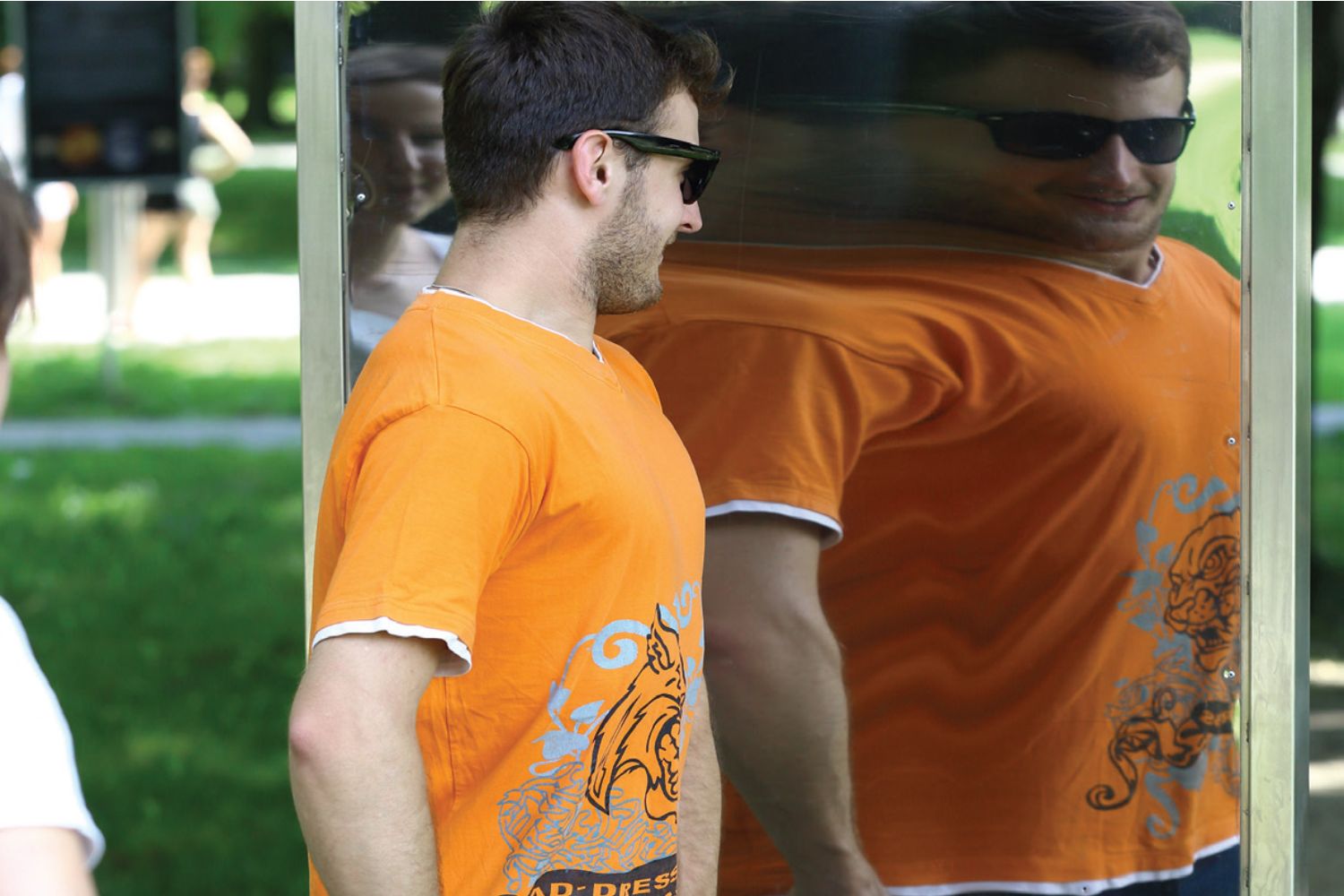
Cylindrical mirror
HOW
1. Stand in front of the mirror. Raise one hand. What can you see?
2. Observe how the image changes as you approach and move away from the mirror.
3. Conduct the experiment by standing on either side of the mirror.
WHY
The angle of reflection of a light beam is equal to its angle of incidence. An image is formed where the beams illuminating the object intersect after being reflected from the mirror. It is then a real image – one that could be projected on a screen set up in front of the mirror (Fig. 1).
If the beams reflected from the mirror diverge, the image is formed at the intersection of their extensions – ‘on the other side of the mirror’ (Fig. 2). It is a virtual image. This means that it cannot be seen on the screen. If the reflected beam from the mirror is parallel, no image is formed.
If you illuminate a mirror with a parallel light beam, the reflected rays or their extensions intersect at a single point. This point is the focus – real (F) or virtual (F’). Its distance from the mirror is the focal length. The distance an object is positioned from the mirror affects the characteristics of the resulting image.
In a convex mirror (Fig. 2), a smaller image is always produced. Therefore, the reflection is ‘slimmed down’ in it – the further away from the mirror one stands. A concave mirror (Fig. 1) magnifies if an object is between it and the doubled focal point (exception – placing an object in the focal length itself will result in no image). Positioning the object behind the doubled focal point (point O) produces a diminishing effect. An additional effect occurring in a concave mirror is the inversion of the image for an object placed beyond the focus (Fig. 1).