


 zajezdnia
 ogród doświadczeń
 hangar czyżyny


Three forces
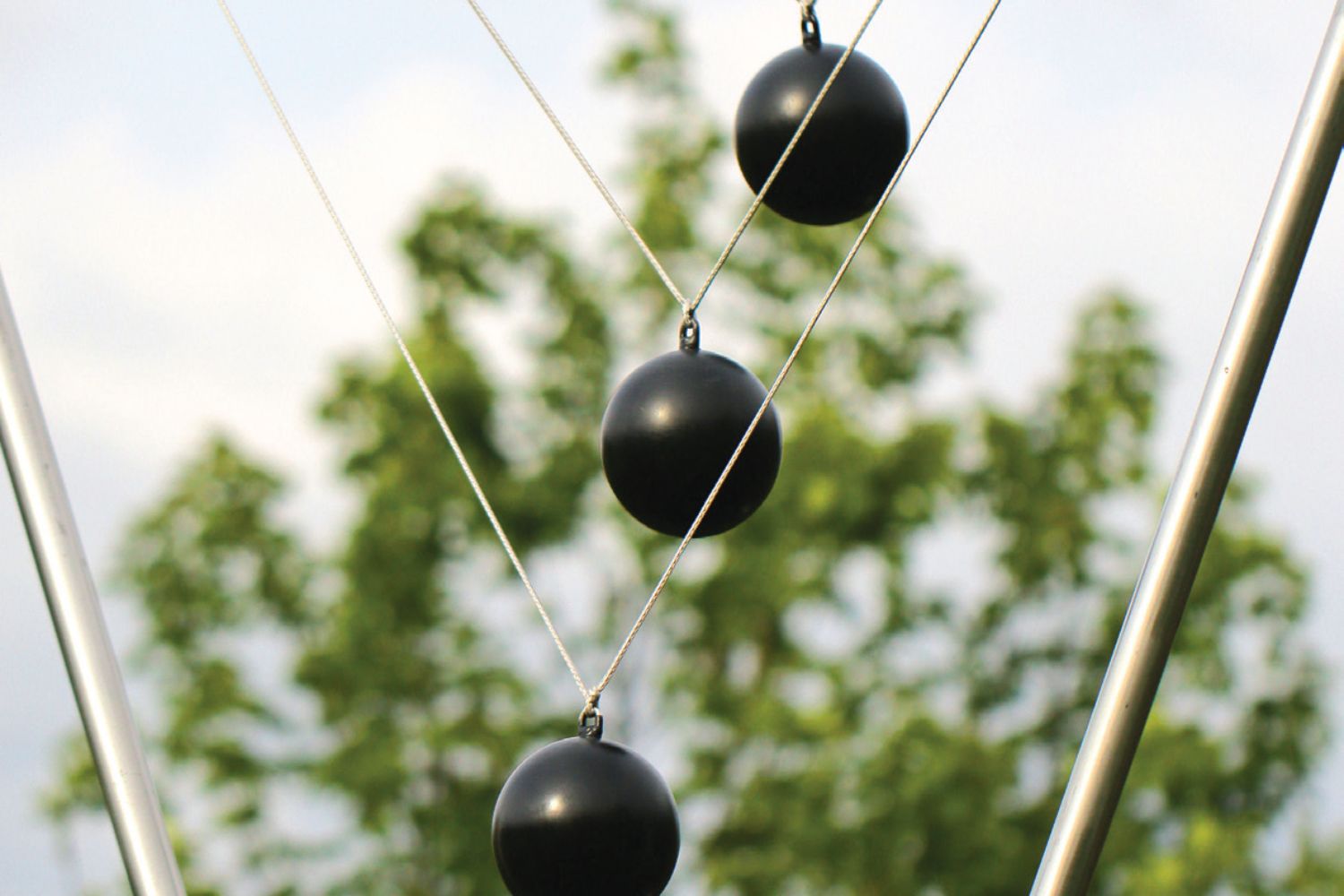
Three forces
HOW
1. Pull the rope rhythmically – alternately, for a second or so on each side.
2. Try to get the pendulums to vibrate. You will only succeed at a certain specific frequency. Find it. Getting all three pendulums to vibrate simultaneously with a large amplitude is not possible.
3. Note that the greater the length of the pendulum (the longer the ropes on which the ball hangs), the longer its vibration time. As a result, you are less likely to have to pull the rope to rock them.
WHY
When the vibrations of the pendulum are small, they can be regarded as harmonic with a good approximation. Such vibrations occur when a force acts on a body that is proportional to the deflection from the equilibrium position and directed opposite to this deflection.
Each pendulum has a different natural period. This is the ‘full swing’ time after it has been swung out of its equilibrium position and allowed to move freely. Each one also has a different frequency (inverse of the natural period).
The greater the length of the pendulum, the longer the period and the lower the natural frequency. If you pull the ropes at the same frequency with which the pendulum vibrates (the frequency of the applied periodic force is equal to its natural frequency), the phenomenon of resonance occurs. The amplitude of the pendulum’s vibration can then assume a maximum value.
The frequency for which the vibration has the greatest amplitude is called the resonance frequency. Each pendulum has a different length, so a different frequency of periodic force is needed to set it into high amplitude vibration. Achieving this effect for all three pendulums simultaneously is not possible.